# Secure Communication --- ### Goals for Secure Communcation * Make sure who am I talking to * No one else can see my messages in transit --- These have to be user-facing * People, not computers, are important * Users need to understand to know how to use * Encryption is mostly invisible --- ### Symmetric Encryption * Key + Message = ciphertext * Ciphertext + key = Message * Fast, efficient * Lots of algorithms, many easily broken --- ### Symmetric Encryption * Assumption: if you know the key, you must be who you say * Control over keys important --- ### Assymmetric Encryption * Public Key -- Private Key (pair) * Message + public key = ciphertext * ciphertext + privacy key = message * (or vice versa) --- ### Assymmetric Encryption * Slow, complicated * Often used to share randomly generated symmetric keys * Used forwards --> encrypt messages * Used backwards --> sign messages --- ## Secure Communication Systems --- ### PGP / GPG **Pretty Good Privacy** Encryption * Public key encryption --> symmetric key * Only encrypts body of email, not subject or TO/FROM * Can also *sign* emails to verify sender Key Management * "Web of Trust" -- Sign other people's keys --- ### SSL / TLS **"Lock icon" in browser** Encryption * Public key encryption --> symmetric key * Encrypts all contents, but not who is communicating Key Management * Certificate System -- Root certs, hierarchy of trust --- ### Messages / Messanger / most chat apps Encryption: * Symmetric Key, end-to-end * Encrypts just contents, not metadata Key Management * Centralized, run by company --- ### Signal Chat Encryption: * Symmetric key, end-to-end * Phone-based, uses phone number for ID Key Management * "Safety Numbers" derived from key --- ## Ceremonies --- **Ceremony**: A sequence of steps that *users* need to do to ensure a specific security outcome --- ### Example Ceremony: Signal 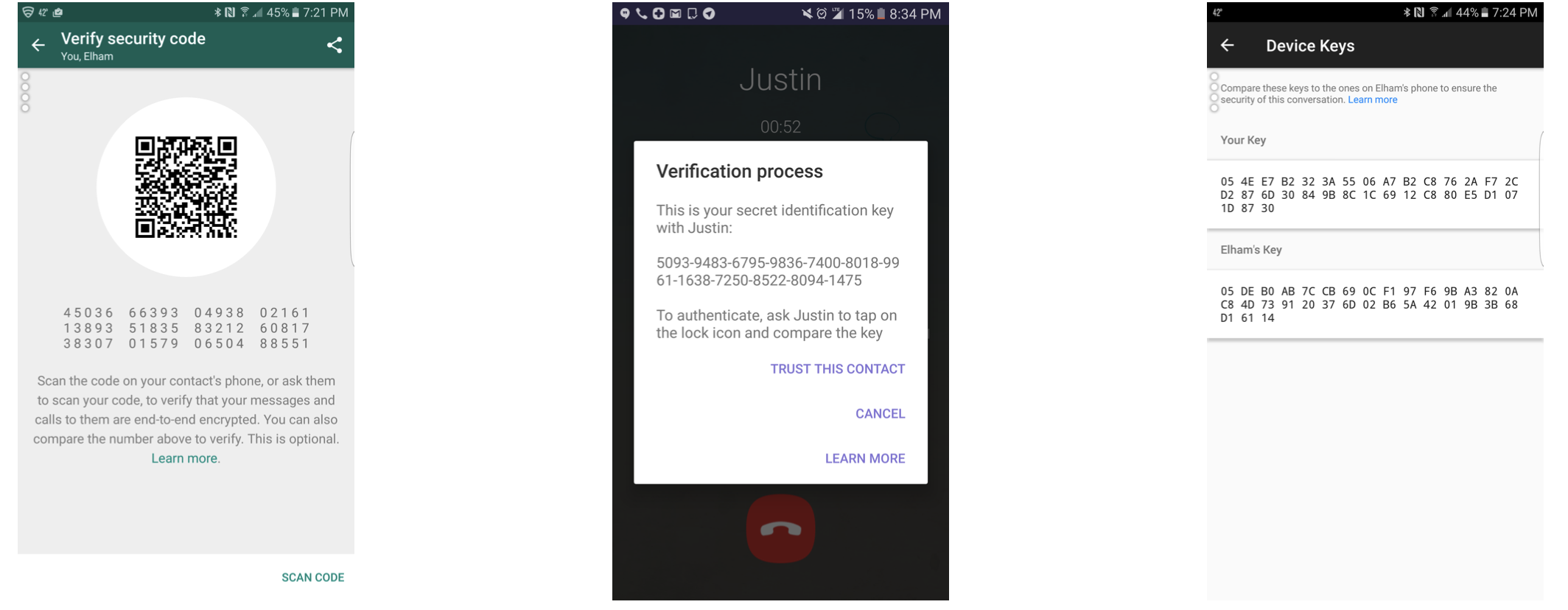 Note: 14% of participants were able to do this 78% after hearing about importance of keys --- ### Other Ceremonies * Check website "lock icon" * Use of private browsing * Two-factor Authentication * Report phishing email --- ## Mental Models of Encryption 1. Access Control 2. Black Box Transform 3. Replacement Cipher 4. Iterative Encryption --- ### Obstacles to Secure Communications * Fragmented user bases * Not understanding encryption * Not understanding signing / key management