Assignment: Cookie Nutrition Label
For this assignment, your goal is to design a nutrition label style approach for privacy and cookies.
You can do this by yourself or you are allowed to work with a partner from class. When working with a partner, you both much submit the same thing to Canvas, and both members will receive the same grade.
Overview
There is a law (regulation) in Europe called GDPR that is intended to protect people’s privacy. It requires any website that uses cookies to get explicit, informed user consent for their use. One consequence of that law is the ubiquitous “cookie dialog” that many websites use to get consent for the use of cookies. Here is one example:
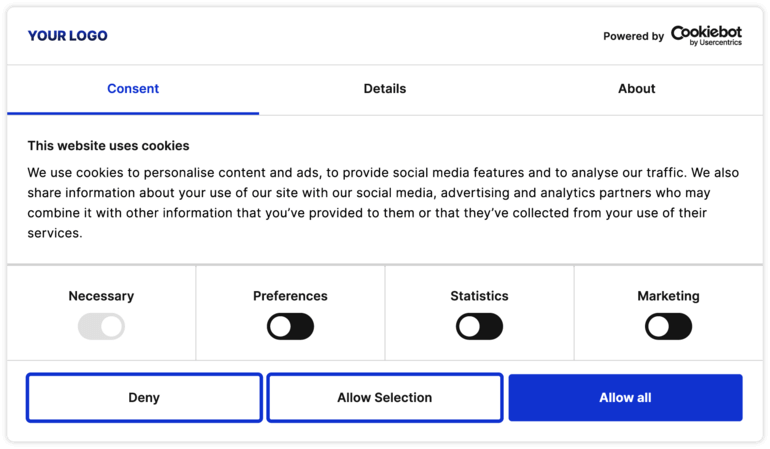
The majority of these dialogs provide some basic information about cookies and what they do, and then ask users to agree to the use of cookies. Some allow users to provide some input (e.g. “Only necessary cookies”), but even those usually use defaults to get people to consent to as many cookies as possible.
Users generally find it very difficult to understand what they are agreeing to, and what the differences are between websites. For example, which 3rd parties are they sharing information with? How does that information get combined with other people’s data?
Your job is to design a new “nutrition label” style approach to cookie dialogs, that tries to actually inform users about things what they want to know, and helps them make more truly informed decisions.
(Aside: Yes, the companies that make these dialogs have a strong economic incentive to NOT actually inform users appropriately, and instead trick/default users into invasive cookie use. This is why they haven’t created such a nutrition label yet, despite “informed consent” being the legal GDPR requirement. Let’s ignore that fact for the moment, and design a nutrition label approach under the assumption that the website will WANT users to really understand. Such a label could be used by companies that make privacy protection a feature, or could be mandated for use by a court or the government.)
Types of Cookies, Uses, and Privacy Concerns
Your first step is to understand the details of what is being asked of users. We’ve talked about cookies in general, but these dialogs ask users to consent to specific cookies that are being used by specific companies in order to track specific types of data. Those details matter. There may be some situations a person will want to consent to cookies, and the same person will not want to consent for a different cookie, or a different compay, or a different type of tracked data, or a different website.
First, you will need to make a list of the different types of cookies. Since this consent is for a techical feature (specific cookies), you will have to know exactly what those cookies are. Note, each website might have multiple cookies, and might use those cookies for different purposes. Make a list of ALL the cookies that websites use, and be as specific as you can. Websites often group cookies into categories (e.g. “required” cookies, “advertising” cookies, etc.). However, you might want to group them differently. So make a list of actual cookies, not just the broad categories that websites currently show.
Second, you’ll need to think about the uses of those cookies and the potential privacy concerns. This is important – think about all the ways that each of these cookies might impact security and/or privacy. For each cookies, you’ll need to list 1) what the cookie is used for, and why the websites wants/needs it, and 2) what the potential privacy concerns are with using that cookie.
Nutrition Label Design
Once you have information about cookies, you can try to design a “nutrition label”. You should (hopefully) have a LOT more detailed, and probably technical, information than most users want or will understand. And it is probably a lot longer than most users want to read in a cookie dialog. You will need to figure out how to condense this information into the most important pieces of information.
Think about actual nutrition labels on food packaging. Food is complicated, but nutrition labels decided that certain pieces of information are the most imporatant – total calories (in big print), amounts of protein, carbs, and fats; percentage of recommended daily allowance; amounts of sugars and added sugars; ingredients list in order by weight; vitamins and nutrients; and serving size.
What is the equivalent for cookies and privacy/security? We read about the design of nutrition labels for Internet-of-things devices. What are the most important facts about cookies that a user will want to know?
Specifically focus on things that may change or be different between different cookies and/or different websites, and also things that are not normally obvious.
Try to put together a visual design that finds a nice, informative way to convey this information. Mock up this nutrition label for a number of common / popular websites so that you can see how it might look different for different websites.
Prototype
Create a prototype / initial mockup of your nutrition label. This can be a paper prototype, a figma prototype, an electronic drawing, or anything else.
Actually, you will need to create more than one instance of this prototype – you’ll need to create variations on your prototype for different websites that have different levels of cookie use.
Think about what kinds of websites exist – brand advertising, social media, univeristy classes, online stores, etc. Different websites will have different cookie needs. Identify 3 websites that will have very different cookie needs and consequently very different privacy concerns. Then create different versions of your prototype with different information that corresponds to those websites.
Initial User Evaluation
Now it is time to try out your design, and see if people can use it. You must conduct an evalation of your prototype with an actual user. Find someone, and then set up a time to meet them and use your prototype. Give them a realistic and reasonable task to do that involves visiting the websites you have prototypes for. Give them your prototype cookie notice when they visit the website, and see how they react. After this use, you can then ask them more questions or to explore your prototype more fully.
Since the prototype isn’t real, you will have to walk them through the various screens that you create. You will have to think carefully how to do this – do you mockup the whole website? do you insert your digital prototype into an existing website using some sort of browser plugin?
The whole time, you should be taking notes. What is going well? What is the user stumbling over? Where tasks are the user able to figure out? Where does the user seem confused, or slow?
Revised Design
Use the results of your user evaluation to revise your prototype nutrition label. Now that you’ve seen a user use it, what might you do differently? What should you change? What is working well that you want to keep? Make the revisions, and create a new set of prototypes.
Detailed User Evaluation
Next, you should do a more detailed user evaluation with a second, different user.
Start by doing the same user evaluation you did previously, but with your new design. Ask them to visit multiple websites, and interact with your cookie nutrition label as they naturally would. Then ask them questions about how they interpreted it. Take detailed notes the whole time.
THEN, after they have completed their “natural” use, give them a specific set of concerns and see if they can use the nutrition labels you’ve created to figure out their concerns. That is, ask them to role play and pretend that they are specifically concerned about one or more specific privacy issues, and then ask them to use the cookie notices to see if the notice helps them. Try to give them at least 3 different types of privacy concerns that they might have.
For example, you could tell user “pretend that you are currently in a dispute with Facebook after they removed some content of yours. You now want to browse the web and look up information related to that dispute, but don’t want Facebook to track your browsing.”
Come up with three scenarios like this that involve privacy concerns that might be related to cookies. Ask the user to role play those scenarios, and see if the nutrition labels you designed are useful in helping the user address those concerns.
This is a summative evaluation of your nutrition label. Does it work? Does it actually help people? Is it easy enough to use that people can use it with realistic privacy concerns?
Write a Design Report
Finally, you should write a report that contains all of your final design and the reasoning (including data) behind the design. Pretend that the company making this technology exists, and write up the design for them.
The report should contain:
- The final design that you arrived at, and the reasons why it is designed the way it is.
- The initial design you started with.
- Findings from your initial user evaluation, and
- A list of changed you made to your initial design, and the reasons behind those changes
- Findings from your summative evaluation: does the design work? Is it useful? What about it works and doesn’t work?
The report might be short, but it also might be long because it should contain images with your designs. The actual text by itself (without images) should fit within 5-8 pages, but the document can be longer with design images.
Your report should also include an appendix that includes:
a. Your notes (with any sensitive information redacted) from the user evaluation. b. Either a working link to your prototype, or photographs of the paper prototype that was used in the user evaluation. c. Dates/times of the user tests d. Any intermediate designs that did not appear in the report
Due: Friday, Dec 12, 1pm